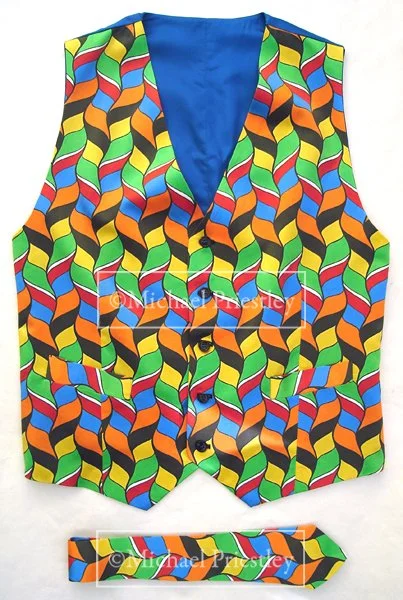
Silk Waistcoat and Tie. The Baldacchino and Royal Mail Chester Mail Centre Colours. 2025-2026.
My young third cousin Richard Bannan is part of the choir at St George’s Chapel at Windsor Castle. In October 2025 this choir accompanied the King on his visit to the Vatican and sang before King and Pope in the Sistine Chapel, along with the Chapel Royal and Sistine Chapel Choirs. Next to the Sistine Chapel is St Peter’s Basilica. Inside St Peter’s is the Baldacchino of 1623-34, a towering huge bronze canopy situated over the high alter and St Peter’s tomb. Not only is this a tour de force of baroque design by the sculptor and architect Bernini but also an equal tour de force by the craftsmen who turned Bernini’s designs into cast bronze reality. The canopy of the Baldacchino is supported on four cast bronze barley twist columns, of which the lower parts have a spiral shape cut into them. I wanted to design another Baroque inspired silk waistcoat to compliment my other one which is based upon a strict geometrical pattern of coloured triangles and shapes derived from those triangles. So I thought it would be interesting to take the Baldacchino barley twist and spiral shapes and to design a pattern based upon those elements. For colour, I decided on a simple colour palette derived from colours used to aid mail sorting at the Royal Mail Chester Mail Centre which is where I used to work. I am keenly interested in railways and those colours at Royal Mail are all based upon colours used by the Great Western Railway, GWR and the London, Midland and Scottish Railway, LMSR, with the exception of white, which I have used in my design as focal points. Finally as a Christian it is also no accident that the seven colours chosen also represent the seven spirits or characteristics or attributes of God mentioned in Isaiah 11 verses 2-3 and also in Revelation 4 verse 5 and Revelation 5 verse 6.
So in Chester Mail Centre the geographical areas covered by the Mail Centre are colour coded. When I started work at the Mail Centre the areas coded green, Wrexham, Llangollen, Corwen, Bala, Dolgellau, Tywyn and Barmouth with the exception of Wrexham, were known as the 'westerns'. I thought that this was a reference to the fact that those areas are to the 'west' of Chester. However at the Mail Centre it was a friend, David Parry, who mentioned that those were all served by the former GWR, hence the term 'westerns'. Wrexham was also served by the GWR, but for Royal Mail purposes was kept separate from the other greens. The GWR painted its steam locomotives 'GWR loco green', so at the Mail Centre these became coded green.
The LMSR served Chester, Mold, Buckley, Deeside, Flint and Holywell and painted its goods steam locomotives black, so at the Mail Centre these are coded black.
The LMSR also served Colwyn Bay, Llandudno, Conwy, Penmaenmawr, Llanrwst, Betws y Coed and Blaenau Ffestiniog and painted most of its passenger steam locomotives crimson lake, a dark red, so at the Mail Centre these are coded red.
The LMSR also served Prestatyn, Rhyl, Denbigh, Ruthin and Abergele. From 1936 the LMSR painted some of its stations sky blue with cream. So at the Mail Centre these are coded blue.
The LMSR also served Bangor, Caernarfon, Llangefni, Amlwch and Holyhead. Again from 1936 the LMSR decided to paint its station name boards yellow with black lettering, so at the Mail Centre these are coded yellow. For Royal Mail operating reasons Porthmadog and Pwllheli are also coded yellow even though they were on the GWR system.
For the Wirral, mostly served by the LMSR, the Mail Centre code here is orange. I believe that orange was chosen because it is a lighter version of LMSR crimson lake.
Coincidence or God-ordinance, in that there are seven colours including black and white, the number seven representing God.
The silk fabric was supplied by and printed on by Contrado and the waistcoat and tie were made by Harris & Howard Bespoke Tailors.